
Why I Keep Going Back to the Classroom Reflections on NSS 2026 and the Anatomy for Injectors Workshop
Earlier this month I travelled to Sydney for the first time to attend the Non-Surgical Symposium - Australia's leading educational conference for non-surgical aesthetics - alongside two pre-symposium workshops I had been looking forward to for some time.
I want to share a little about why these events matter to me - not as a promotional exercise, but because I think patients deserve to understand what ongoing clinical education in this field actually looks like, and why it should matter to them.
The Anatomy for Injectors Workshop
The AFI is run under the Australasian Society of Aesthetic Plastic Surgeons and is, in my view, one of the most rigorous educational experiences available to aesthetic practitioners in this country. It takes place at the Surgical and Anatomical Science Facility at the University of Technology Sydney - a proper anatomy lab - and the program centres on fresh cadaver dissection.
That setting matters. Three-dimensional anatomy looks different on a cadaver than it does in a textbook or on a screen. You see the variation. You see why the same injection point carries different risk depending on the individual in front of you. You develop a spatial understanding of facial structure - the layers, the vessels, the danger zones - that simply cannot be replicated any other way.
This year's faculty included specialist plastic surgeons, dermatologists, cosmetic physicians, and experienced nurse injectors. Sessions covered the upper face, midface, periorbital region, perioral area, jawline, and neck - with a particular focus on arterial anatomy and the clinical relevance of vascular variation.
I attend this workshop not because it is required, but because I believe the standard of care I can offer my patients is directly connected to the depth of my anatomical knowledge. Aesthetic medicine carries real risk. Understanding that risk - at a structural level - is part of practising it ethically.
The Living ART Ultrasound Workshop
Alongside the AFI, I attended the Living ART Ultrasound Workshop, led by Dr Stefania Roberts.
Ultrasound is increasingly being recognised as an important tool in aesthetic practice - not just for complication management, but as part of pre-treatment assessment and planning. The workshop covered the fundamentals of facial ultrasound including B-mode and Doppler imaging, hands-on scanning technique, filler recognition, and ultrasound-guided injection practice.
Integrating ultrasound into practice takes time and ongoing development. This workshop was a significant step in building that skill set, and it sits alongside the ultrasound-guided assessment and vascular mapping I already use at Savu Studio as part of my clinical consultation process for appropriate patients.
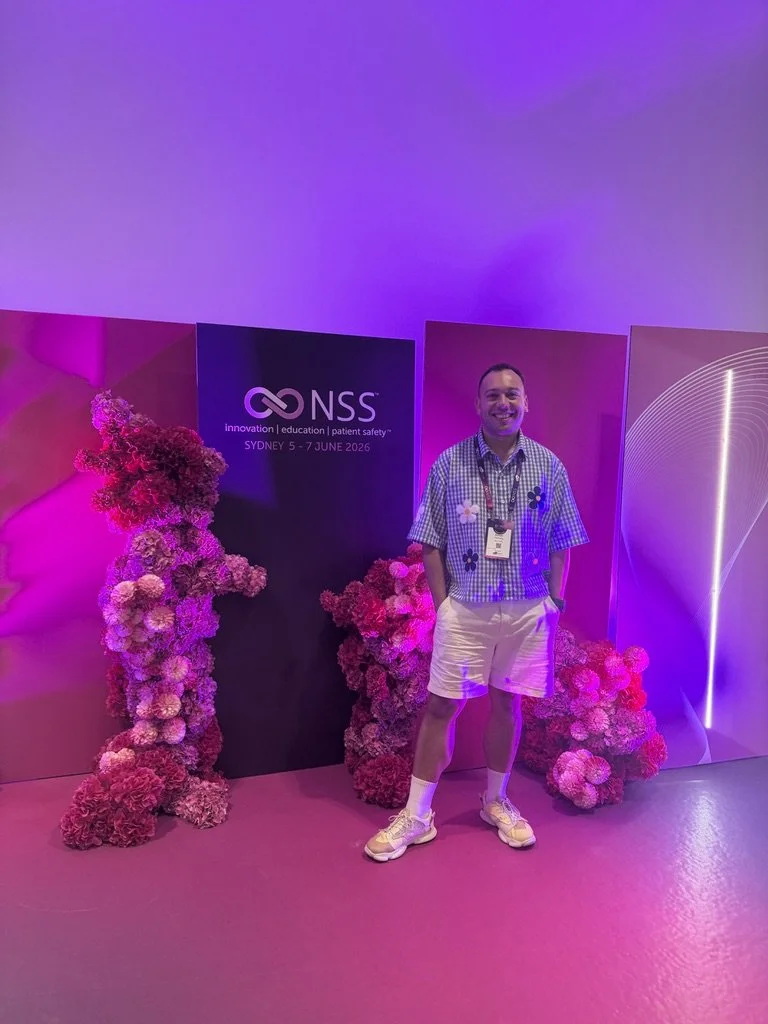
Non-Surgical Symposium, Sydney, June 2026
The Non-Surgical Symposium
The NSS is Australia's leading educational conference for non-surgical aesthetics, and this was my first time attending. Bringing together plastic surgeons, dermatologists, cosmetic physicians, nurse practitioners, and allied practitioners over three days, it exceeded what I had expected from it.
The program covers clinical technique, emerging research, energy-based devices, hair restoration, skin health, and importantly - industry guidelines and compliance.
I value the NSS not only for the clinical content but for the conversations it facilitates. Sitting alongside specialists from different disciplines, hearing how they approach shared clinical problems, and having frank discussions about standards, complications, and evolving evidence - that professional exchange is something I carry back into my practice.
Why this matters for your care
I am aware that in aesthetic medicine, continuing education is sometimes marketed as a credential - a line on a website designed to build confidence rather than reflect genuine commitment. I want to be honest about why I invest in events like these.
Aesthetic procedures carry clinical risk. The face is anatomically complex and individually variable. The margin between a good outcome and a serious complication can be narrow, and it narrows further when knowledge is superficial or technique is stale. I attend these workshops because I want to be genuinely good at what I do - not just compliant with what is required.
If you have questions about my approach to clinical practice, training, or how I assess suitability for treatment, I'm always happy to discuss that at your consultation.

Sydney, June 2026
